
Last Updated: 22 August 2026 | Verified from official UPSC and Indian Air Force notifications released in May 2026. We update this guide whenever a new notification changes any date or eligibility rule.
What Are Defence Exams 2026?
Defence Exams 2026 refer to the competitive examinations that recruit officers into the Indian Army, Navy, and Air Force: NDA, CDS, and AFCAT. UPSC conducts NDA and CDS twice a year for entry after Class 12 and after graduation respectively, while the Indian Air Force conducts AFCAT twice a year for Flying and Ground Duty officer roles. This guide covers eligibility, notification dates, exam pattern, syllabus, SSB interview, cut-off trends, salary, and preparation strategy for all three.
Every year, lakhs of young Indians dream of trading their college ID cards for an officer’s uniform. If you’re one of them, three exams stand between you and that dream: NDA, CDS, and AFCAT. Each one opens a different door into the Army, Navy, or Air Force, and each one runs on its own calendar, eligibility rules, and exam pattern. Mixing them up, or missing a deadline because you assumed all three worked the same way, is one of the most common and most avoidable mistakes aspirants make.
This guide brings together everything you need for the 2026 exam cycle: notification dates, eligibility, application steps, exam pattern, cut-off trends, and what happens after the written exam. Whether you’re a Class 12 student eyeing the NDA, a graduate weighing CDS, or someone drawn specifically to flying with AFCAT, you’ll find the details below.
Table of Contents
- What Are NDA, CDS, and AFCAT?
- Which Defence Exam Should You Choose?
- NDA vs CDS vs AFCAT: Quick Comparison
- NDA 2026: Notification, Eligibility, Pattern & Syllabus
- CDS 2026: Notification, Eligibility, Pattern & Syllabus
- AFCAT 2026: Notification, Eligibility, Pattern & Syllabus
- How to Apply Online: Step-by-Step Process
- Documents Required for Application and SSB
- SSB Interview: What Happens After the Written Exam
- Physical and Medical Standards
- Cut-Off Trends: NDA, CDS & AFCAT
- Common Mistakes Aspirants Make
- Preparation Strategy and Recommended Books
- Exam Day Guidelines
- Selection Timeline: Application to Joining
- Salary, Training, and Career Growth
- Official Websites and References
- Frequently Asked Questions
What Are NDA, CDS, and AFCAT?
All three exams lead to a career as a commissioned officer, but they target different entry points and educational stages. Each also feeds into either a Permanent Commission or a Short Service Commission, depending on the academy and branch you join.
NDA (National Defence Academy) accepts students who have just finished, or are about to finish, Class 12. UPSC conducts it twice a year. It’s the only one of the three that trains cadets for all three services together at Khadakwasla, Pune, before they branch out to the Indian Military Academy, Indian Naval Academy, or Air Force Academy.
CDS (Combined Defence Services) targets graduates. UPSC recruits through this route into the Indian Military Academy (IMA), Indian Naval Academy (INA), Air Force Academy (AFA), and the Officers’ Training Academy (OTA). OTA remains one of the few defence entries open to women for a full officer commission.
AFCAT (Air Force Common Admission Test) is run directly by the Indian Air Force, not UPSC. It recruits graduates and engineers into the Flying Branch and Ground Duty (Technical and Non-Technical) branches. The Air Force Selection Board (AFSB) and the Computerised Pilot Selection System (CPSS) both come into play later in this process for Flying Branch aspirants.
Picking the exam that matches your current qualification is your first real decision — everything else, from syllabus to SSB, follows from that choice. If you’re aiming for a soldier-level entry into the Army rather than an officer’s commission, the Agniveer route follows a completely different notification and exam pattern — see our detailed guide on Agniveer Bharti 2026 notification, exam date & admit card for that path.
Which Defence Exam Should You Choose?
Use this quick decision table to shortlist the exam that fits your current stage and goal.
| If You Are… | Best Exam |
|---|---|
| Class 12 student (any stream, for Army Wing) | NDA |
| Class 12 student with Physics & Maths (Navy/Air Force Wing) | NDA |
| Graduate in any discipline | CDS (IMA/OTA) |
| Engineering graduate | CDS (INA/AFA) or AFCAT |
| Want to become a fighter/transport pilot | NDA (Air Force Wing) or AFCAT Flying Branch |
| Woman aspiring for a commission | NDA, CDS (OTA), or AFCAT (all branches) |
| Want Army specifically | NDA or CDS (IMA) |
| Want a Short Service Commission via OTA | CDS |
NDA vs CDS vs AFCAT: Quick Comparison
| Parameter | NDA | CDS | AFCAT |
|---|---|---|---|
| Conducted By | UPSC | UPSC | Indian Air Force |
| Eligibility | Class 12 pass/appearing | Graduate/final year | Graduate/Engineering |
| Age Limit | 16.5 – 19.5 years | 19 – 25 years (varies by academy) | 20 – 26 years (varies by branch) |
| Academies | NDA Khadakwasla | IMA, INA, AFA, OTA | Air Force Academy, Dundigal |
| Women Eligible | Yes | Yes (OTA only) | Yes (all branches) |
| Exam Frequency | Twice a year | Twice a year | Twice a year |
| Exam Mode | Offline (Pen & Paper) | Offline (Pen & Paper) | Online (Computer-Based) |
| Selection Process | Written + SSB | Written + SSB | Written + AFSB + CPSS (Flying) |
| Commission Type | Permanent Commission | Permanent (IMA/INA/AFA) / Short Service (OTA) | Permanent or Short Service Commission |
NDA 2026: Notification, Eligibility, Pattern & Syllabus
UPSC released the NDA & NA (II) 2026 notification on 20 May 2026 for the 158th NDA Course and the 120th Indian Naval Academy Course, with training set to begin on 1 July 2027. This cycle carries 394 vacancies — 370 for male candidates and 24 for female candidates — across the Army, Navy, and Air Force wings.
NDA 2026 Important Dates
| Event | Date |
|---|---|
| Notification Release | 20 May 2026 |
| Online Application Start | 20 May 2026 |
| Last Date to Apply (extended) | 11 June 2026 |
| Written Examination | 13 September 2026 |
| Course Commencement | 1 July 2027 |
UPSC periodically extends application windows. Check the official UPSC application portal a few days before any deadline rather than relying only on the originally published date.
NDA 2026 Eligibility Criteria
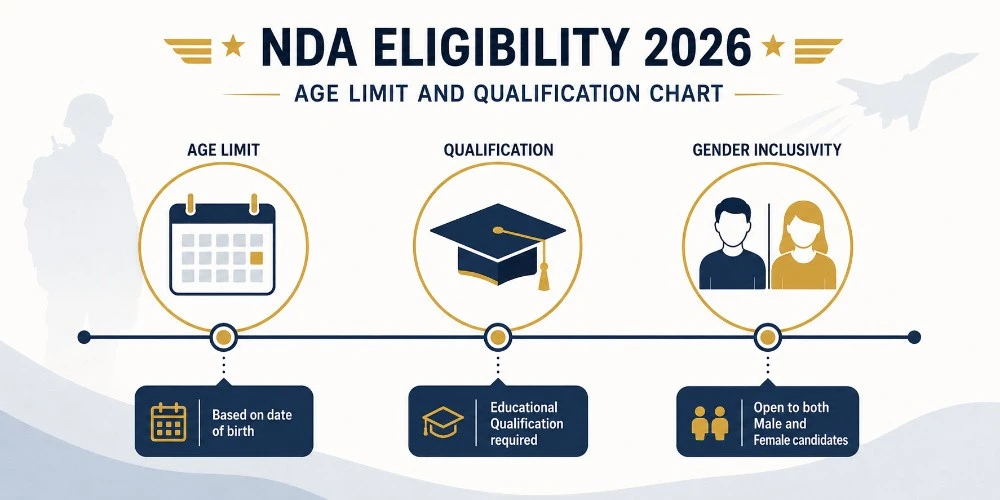
- Age: Unmarried candidates born between 2 January 2008 and 1 January 2011 (16.5 to 19.5 years).
- Educational Qualification (Army Wing): Class 12 pass or appearing under the 10+2 pattern from a recognised board.
- Educational Qualification (Air Force & Naval Wings): Class 12 pass or appearing with Physics and Mathematics.
- Gender: Both male and female candidates can apply; candidates must stay unmarried throughout training.
- Nationality: UPSC accepts Indian citizens, subjects of Nepal/Bhutan, Tibetan refugees who settled in India before 1 January 1962, and persons of Indian origin who migrated from specified countries with the intention of permanent settlement.
NDA 2026 Exam Pattern
UPSC conducts the written exam offline in MCQ format, in both English and Hindi, across two papers held on the same day.
| Paper | Subject | Duration | Marks |
|---|---|---|---|
| Paper 1 | Mathematics | 2.5 hours | 300 |
| Paper 2 | General Ability Test (English + General Knowledge) | 2.5 hours | 600 |
| — | SSB Interview | — | 900 |
UPSC deducts 0.83 marks for every wrong answer in Mathematics and 1.33 marks for each incorrect answer in the General Ability Test.
NDA 2026 Syllabus (Brief)
- Mathematics: Algebra, Matrices & Determinants, Trigonometry, Analytical Geometry (2D & 3D), Differential and Integral Calculus, Vector Algebra, Statistics & Probability.
- English (Part of GAT): Grammar, comprehension, vocabulary, and usage-based questions.
- General Knowledge (Part of GAT): Physics, Chemistry, General Science, History, the Freedom Movement, Geography, and Current Events.
Candidates who clear the written exam move to the SSB interview — see the SSB Interview section below for a full breakdown.
CDS 2026: Notification, Eligibility, Pattern & Syllabus
UPSC released the CDS (II) 2026 notification on 20 May 2026, opening 451 vacancies across the Indian Military Academy, Indian Naval Academy, Air Force Academy, and Officers’ Training Academy.
CDS 2026 Important Dates
| Event | Date |
|---|---|
| Notification Release | 20 May 2026 |
| Online Application Start | 20 May 2026 |
| Last Date to Apply (extended) | 11 June 2026 |
| Written Examination | 13 September 2026 |
CDS 2026 Eligibility Criteria
Eligibility differs by academy, so read this table carefully before you select your preference.
| Academy | Age Limit | Qualification | Gender |
|---|---|---|---|
| Indian Military Academy (IMA) | Born 2 July 2003 – 1 July 2008; unmarried | Degree from a recognised university (any discipline) | Male |
| Indian Naval Academy (INA) | Born 2 July 2003 – 1 July 2008; unmarried | Engineering degree in a specified discipline | Male |
| Air Force Academy (AFA) | 20 – 24 years | Engineering degree, or a degree with Physics and Mathematics at 10+2 level | Male |
| Officers’ Training Academy (OTA) | 19 – 25 years | Degree from a recognised university (any discipline) | Male & Female |
UPSC also allows final-year students to apply, provided they submit proof of passing their degree before the SSB interview stage. Candidates must hold citizenship of India, Nepal, or Bhutan, or fall under the same refugee and Indian-origin categories recognised for NDA.
CDS 2026 Exam Pattern
| Academy | Subjects | Duration (each) | Marks |
|---|---|---|---|
| IMA / INA / AFA | English, General Knowledge, Elementary Mathematics | 2 hours | 100 each (300 total) |
| OTA | English, General Knowledge | 2 hours | 100 each (200 total) |
UPSC sets Elementary Mathematics at the matriculation level, while English and General Knowledge questions sit closer to graduation-level general awareness. Negative marking applies throughout.
CDS 2026 Syllabus (Brief)
- English: Grammar, vocabulary, comprehension, and error detection.
- General Knowledge: Current affairs, History, Geography, Polity, Economy, and General Science.
- Elementary Mathematics: Arithmetic, Algebra, Trigonometry, Geometry, Mensuration, and Statistics.
UPSC doesn’t cap the number of CDS attempts as long as you remain within the prescribed age limit — so if you miss the cutoff in CDS 1, CDS 2 the same year is a genuine second shot rather than a wasted year.
AFCAT 2026: Notification, Eligibility, Pattern & Syllabus
The Indian Air Force released the AFCAT 02/2026 notification on 20 May 2026 for courses commencing in July 2027, offering 379 vacancies across the Flying Branch and Ground Duty (Technical and Non-Technical) branches. The IAF also accepts applications through NCC Special Entry and GATE Score Entry routes.
AFCAT 2026 Important Dates
| Event | Date |
|---|---|
| Notification Release | 20 May 2026 |
| Online Application Start | 20 May 2026 |
| Last Date to Apply (extended) | 21 June 2026 |
| Written Examination | To be notified on the official AFCAT portal (typically August) |
| Course Commencement | July 2027 |
Unlike NDA and CDS, the Indian Air Force doesn’t fix the AFCAT written exam date at the time of notification — it communicates that date separately through the candidate login portal, so keep checking your registered email and the official AFCAT website closer to the exam window.
AFCAT 2026 Eligibility Criteria
| Branch | Age Limit | Educational Qualification |
|---|---|---|
| Flying Branch | 20–24 years (relaxable to 26 for valid CPL holders) | Minimum 50% in Maths & Physics at 10+2, plus a graduation degree (min. 60%) in any discipline, or a 4-year B.E./B.Tech degree |
| Ground Duty (Technical) | 20–26 years | Minimum 60% in Physics and Mathematics at 10+2, with a relevant engineering degree |
| Ground Duty (Non-Technical) | 20–26 years | Graduation in any discipline (min. 60%) or equivalent professional qualification |
The Air Force accepts both men and women for every branch, including Flying. Candidates must stay unmarried until training ends, and final-year students may apply if they clear any pending backlog and submit proof of graduation by the specified deadline.
AFCAT 2026 Exam Pattern
The Air Force conducts AFCAT as a Computer-Based Examination (CBE) — the only online exam among the three. It runs 100 objective-type questions worth 300 marks in 2 hours.
| Section | Approx. Questions | Marks per Question |
|---|---|---|
| General Awareness | 25 | +3 / -1 |
| Verbal Ability in English | 25 | +3 / -1 |
| Numerical Ability | 25 | +3 / -1 |
| Reasoning & Military Aptitude | 25 | +3 / -1 |
Candidates opting for Ground Duty (Technical) must additionally clear the Engineering Knowledge Test (EKT), a separate 45-minute paper on core engineering subjects.
AFCAT 2026 Syllabus (Brief)
- English: Comprehension, error detection, sentence completion, synonyms/antonyms, cloze test, idioms, and one-word substitution.
- General Awareness: History, Geography, Polity, Economy, Environment, Science & Technology, Defence, and Current Affairs.
- Numerical Ability: Basic arithmetic, percentages, ratios, time-speed-distance, and data interpretation.
- Reasoning & Military Aptitude: Verbal and non-verbal reasoning, spatial ability, and figure-based questions.
How to Apply Online: Step-by-Step Process
The application process for all three exams follows a broadly similar workflow, though the portals differ.
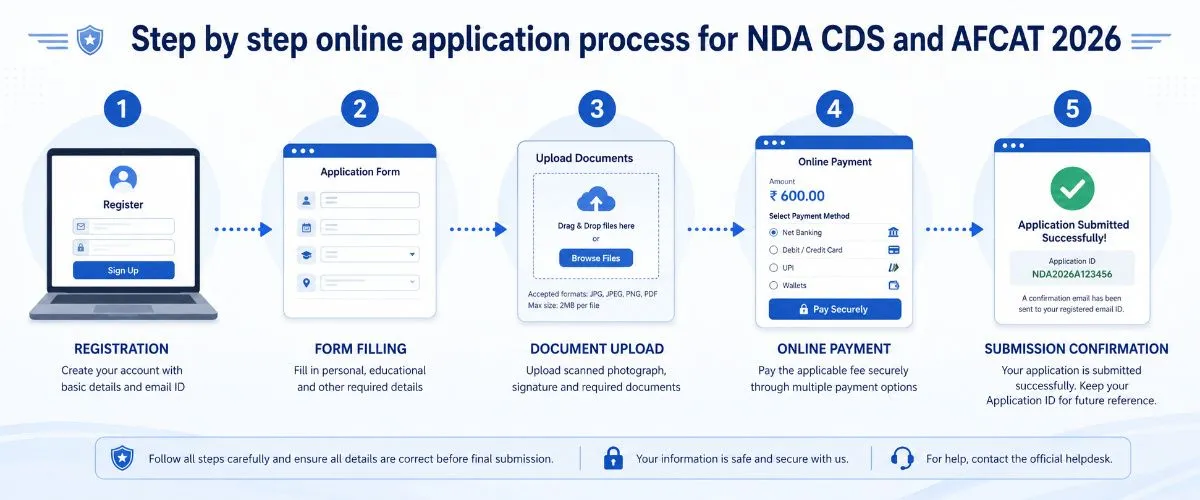
- Visit the official portal — upsconline.nic.in for NDA and CDS, or afcat.edcil.co.in for AFCAT.
- Register with a valid email ID and mobile number to generate your registration ID.
- Fill in personal, academic, and contact details exactly as they appear on your certificates.
- Upload scanned copies of your photograph and signature in the specified format and file size.
- Select your preferred exam centres and, where applicable, your academy or branch preference.
- Pay the application fee online through net banking, debit/credit card, or UPI (SC/ST candidates and, in some exams, female candidates get fee exemptions).
- Review the entire form carefully, submit it, and download the confirmation page for your records.
UPSC and the IAF both treat application fees as non-refundable and non-adjustable against future attempts. Apply a few days before the deadline — server load spikes sharply in the final 24 hours, and a failed submission at that point can cost you the entire attempt. For a broader step-by-step walkthrough that applies to most government exam application forms, see our guide on government exam form kaise bhare 2026.
Documents Required for Application and SSB
Keep these documents ready in scanned and physical form before you start your application — missing paperwork at the SSB stage can delay or disqualify an otherwise successful candidature.
- Class 10 and Class 12 mark sheets and certificates (date of birth proof)
- Graduation degree or provisional certificate (for CDS and AFCAT)
- Category certificate (SC/ST/OBC), if applicable
- NCC certificate, if applying under NCC Special Entry
- Recent passport-size photographs and scanned signature
- Valid photo ID proof (Aadhaar, PAN, passport, or voter ID)
- Domicile or nationality-related documents, where applicable
- Commercial Pilot Licence (CPL), if claiming age relaxation for AFCAT Flying Branch
If your Aadhaar details don’t match your certificates, or you need to know which documents count as valid ID proof, our Aadhaar card 2026 guide covers the full update and correction process.
SSB Interview: What Happens After the Written Exam
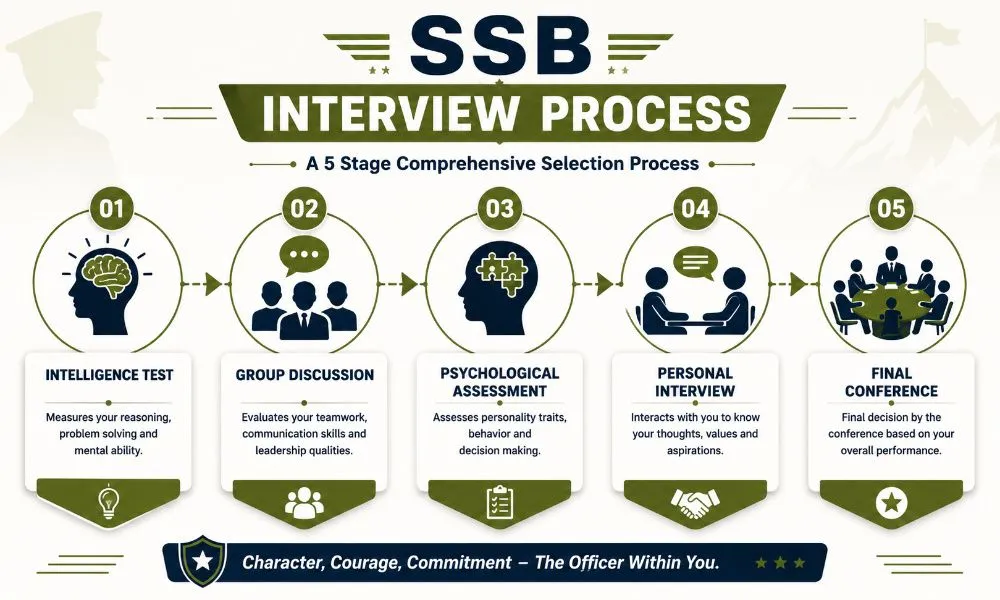
Clearing the written exam is only half the journey. Every candidate who qualifies through NDA, CDS, or AFCAT must then face the Services Selection Board (SSB) — for Air Force candidates, this is called the AFSB. This five-day assessment evaluates leadership, decision-making, and Officer Like Qualities (OLQs), not just academic knowledge.
Stage I
- Officer Intelligence Rating (OIR) Test
- Picture Perception and Discussion Test (PP&DT)
Only candidates who clear Stage I move forward to Stage II, which runs over the following four days.
Stage II
- Psychological Tests (Thematic Apperception Test, Word Association Test, Situation Reaction Test, Self-Description Test)
- Group Testing Officer (GTO) Tasks — group discussions, group planning exercises, progressive and half-group tasks, and the individual obstacle course
- Personal Interview with the Interviewing Officer
- Conference — the Psychologist, GTO, and Interviewing Officer jointly finalise recommendations
The Air Force additionally puts Flying Branch candidates through the Computerised Pilot Selection System (CPSS), which assesses hand-eye coordination and spatial judgment. Recommended candidates then undergo a detailed medical examination before their names appear on the merit list.
Physical and Medical Standards
The forces treat physical and medical standards as non-negotiable — candidates who fail to meet them cannot continue in the selection process, regardless of how well they performed in the written exam or interview.
- Height and Weight: Minimum height requirements vary by service and gender, with proportionate weight-for-height and age standards specified in the official notification.
- Vision Standards: Particularly strict for the Flying Branch, where uncorrected and corrected vision limits are clearly defined; Ground Duty and other academies apply comparatively relaxed norms.
- General Medical Fitness: Medical boards examine cardiovascular fitness, hearing, dental health, and the absence of any condition that could interfere with training or service.
Since exact figures differ across NDA, CDS, and AFCAT — and even across branches within the same exam — always cross-check the physical standards annexure in the current year’s official notification rather than relying on last year’s figures.
Cut-Off Trends: NDA, CDS & AFCAT
Cut-offs fluctuate every cycle based on paper difficulty, the number of vacancies, and how many candidates appear. Treat the figures below as general benchmarks from recent years, not guaranteed targets — UPSC and the IAF release the official cut-off only after results are declared. For a broader look at how cut-offs are trending this year across recruitment bodies, see our UPSSSC cutoff 2026 analysis.
| Exam | Recent Written Cut-Off Range | Minimum Qualifying Marks |
|---|---|---|
| NDA (out of 900) | Roughly 340–360 in recent cycles | 25% in each subject |
| CDS – IMA (out of 300) | Roughly 130–145 | 20% in each subject |
| CDS – AFA (out of 300) | Roughly 155–170 (toughest of the four academies) | 20% in each subject |
| CDS – OTA (out of 200) | Roughly 110–120 | 20% in each subject |
| AFCAT (out of 300) | Fluctuated between roughly 121 and 165 across 2021–2025 | No sectional cut-off; overall score counts |
Among the CDS academies, AFA typically records the highest cut-off because of limited vacancies and stricter medical and aptitude standards. AFCAT’s written cut-off has trended lower in 2024–2025 compared to its 2021 peak, though this can reverse in any given cycle — never assume last year’s number will repeat.
Common Mistakes Aspirants Make
- Ignoring subject-wise qualifying marks: A high aggregate score doesn’t help if you fall below the minimum in even one subject.
- Filling academy/branch preference carelessly: Your preference order affects where you’re finally allotted — treat it as a real decision, not a formality.
- Skipping physical fitness during written prep: Candidates who start running and exercising only after clearing the written exam often struggle at SSB and later in training.
- Underestimating the SSB: Many candidates who ace the written paper get rejected at SSB because they never practised group tasks or the personal interview format.
- Applying at the last minute: Server load near deadlines causes payment failures and incomplete submissions that cannot be corrected afterward.
- Not verifying document formats: Photo and signature uploads in the wrong size or format are a common reason for application rejection.
Preparation Strategy and Recommended Books
A structured approach beats last-minute cramming in these exams. The syllabus is broad, but the question difficulty is moderate — consistency wins over intensity.
General Preparation Tips
- Start with the official syllabus and previous years’ question papers to understand real difficulty and question style.
- Build a daily current affairs habit. Read a newspaper or reliable digital source every day instead of cramming months of news at once.
- Keep a formula notebook for Mathematics-heavy papers (NDA, CDS for IMA/INA/AFA) and revise it weekly.
- Take a full-length mock test under timed conditions at least once a week in the final two months to build speed and accuracy.
- Maintain physical fitness throughout your preparation, not just after clearing the written exam — SSB tasks and training both reward candidates who stay active early.
Recommended Study Resources by Exam
| Exam | Focus Area | What to Prioritise |
|---|---|---|
| NDA | Mathematics + GAT | NCERT Maths (Class 9–12), a dedicated NDA formula book, and full-length mock papers |
| CDS | English, GK, Elementary Maths | Graduation-level GK compilation, matriculation-level maths revision, and an OTA-specific guide if applying there |
| AFCAT | Reasoning + General Awareness | A dedicated AFCAT guide covering reasoning patterns, a current affairs digest, and timed online mock tests |
Pair your subject preparation with previous year question papers for each exam and dedicated SSB Interview practice — written knowledge and interview readiness need separate, parallel tracks rather than sequential ones. For a downloadable, structured preparation plan you can follow week-by-week, see our government jobs preparation guide (PDF).
Exam Day Guidelines
- Reach the exam centre at least 60–90 minutes before the reporting time; authorities close entry gates strictly at the notified time.
- Carry your admit card printout along with one original photo ID proof — no entry without both.
- Bring your own black or blue ball-point pen for offline exams (NDA, CDS); AFCAT’s computer-based format needs no writing instruments.
- Avoid carrying prohibited items such as mobile phones, smartwatches, calculators, or bags into the exam hall.
- Double-check your allotted exam centre and room number on the admit card the night before, not on the morning of the exam.
If you haven’t downloaded your admit card yet, follow our guide on admit card kaise download kare. Agar admit card par naam, DOB ya photo galat lag rahi hai, to turant hamara admit card correction guide dekhein. For a complete pre-exam checklist covering documents and centre rules, see our exam day checklist & center guide.
Selection Timeline: Application to Joining
| Stage | Approximate Timeframe |
|---|---|
| Notification & Online Application | Month 0 |
| Written Examination | Month 3–4 |
| Written Result | Month 5–6 |
| SSB / AFSB Interview | Month 6–9 |
| Medical Examination | Immediately after SSB recommendation |
| Final Merit List | Month 9–11 |
| Course/Training Commencement | Approximately 12–14 months after notification |
This timeline is indicative and varies by exam cycle and academy — always confirm exact dates against the official result and joining notices rather than this general estimate.
Salary, Training, and Career Growth
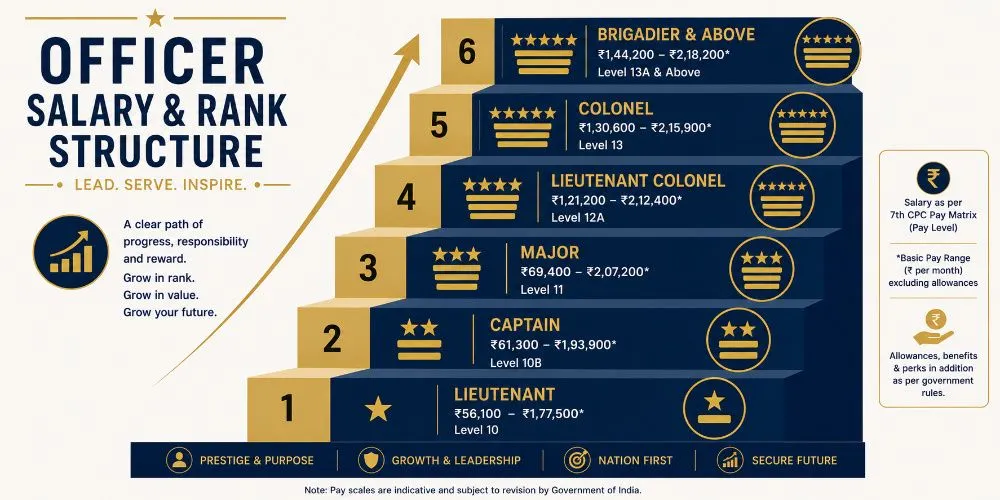
Once commissioned, officers across NDA, CDS, and AFCAT entries draw a starting basic pay of approximately ₹56,100 per month, in line with the 7th Central Pay Commission’s pay matrix for commissioned officers, along with Military Service Pay, Dearness Allowance, and service-specific allowances such as flying allowance, technical allowance, kit maintenance allowance, and transport allowance.
Officers also receive furnished accommodation, subsidised messing, comprehensive medical cover for themselves and their families, and access to Canteen Stores Department (CSD) facilities. Career progression follows a defined rank structure — from Lieutenant or Flying Officer at entry, moving up through Captain, Major, Lieutenant Colonel, and beyond, with promotions tied to time-in-service, performance, and command exposure at each stage.
Official Websites and References
- UPSC Official Website — notifications, syllabus, and results for NDA and CDS
- UPSC Online Application Portal — apply for NDA and CDS
- Official AFCAT Portal — apply for AFCAT and download admit cards
- Join Indian Army — Army-specific entries and career information
- Indian Air Force Official Website — Air Force career and recruitment updates
- Join Indian Navy — Navy-specific entries and career information
Frequently Asked Questions
1. Which defence exam is best after Class 12?
NDA is the natural choice after Class 12, since it’s the only one of the three exams that accepts candidates straight out of school, before they need a graduation degree.
2. Which defence exam is best after graduation?
CDS and AFCAT both suit graduates. Choose CDS if you want the Army, Navy, or a Short Service Commission through OTA; choose AFCAT if you specifically want to fly or join the Air Force’s technical and non-technical branches.
3. Can girls apply for NDA?
Yes. UPSC opened NDA to female candidates across the Army, Navy, and Air Force wings, and they compete on the same written exam and SSB process as male candidates. For more government job options open specifically to women, see our guide on UP government job vacancies 2026 for female candidates.
4. What is the difference between NDA and CDS?
NDA recruits after Class 12 for a tri-service training programme at Khadakwasla, while CDS recruits graduates directly into IMA, INA, AFA, or OTA. NDA cadets train together for three years before specialising; CDS candidates join their specific academy immediately.
5. What is the difference between NDA and AFCAT?
NDA is a UPSC exam for Class 12 students wanting entry into any of the three services, while AFCAT is an Indian Air Force exam exclusively for the Air Force, open to graduates and engineers rather than school students.
6. What is the difference between CDS and AFCAT?
CDS is a UPSC exam covering the Army, Navy, and Air Force academies together, while AFCAT is conducted independently by the Indian Air Force and applies only to Air Force branches. AFCAT is also computer-based, whereas CDS remains a pen-and-paper exam.
7. Which defence exam offers the highest salary?
Starting basic pay is broadly similar across NDA, CDS, and AFCAT entries, since all commissioned officers follow the same 7th Pay Commission matrix. Actual take-home pay varies more by branch-specific allowances, such as flying allowance for pilots, than by which exam you entered through.
8. Can I join the Army without clearing NDA?
Yes. CDS through IMA or OTA is a direct alternative route into the Army for graduates who didn’t attempt or clear NDA after Class 12. If you’re open to a soldier-level role instead of an officer’s commission, also check the Agniveer Bharti 2026 notification.
9. Is there a limit on the number of attempts for these exams?
None of the three exams impose a fixed attempt limit. You can appear as many times as you like, provided you stay within the prescribed age limit for that exam and branch.
10. What happens if I clear the written exam but fail the SSB?
You aren’t selected for that cycle, but you can reapply in the next notification if you still meet the eligibility criteria. Many successful candidates clear the written exam on their first attempt but need two or three SSB attempts before getting recommended.
11. Do I need coaching to clear these exams?
Coaching isn’t mandatory. Many candidates clear these exams through self-study using NCERT books, previous years’ papers, and disciplined mock-test practice. Coaching can add structure and SSB-specific guidance, but it doesn’t replace personal effort.
12. Is the AFCAT exam date fixed like NDA and CDS?
No. UPSC announces the NDA and CDS written exam dates along with the notification itself, but the Indian Air Force communicates the AFCAT exam date separately after the application window closes, usually through the candidate login portal.
Conclusion
NDA, CDS, and AFCAT each offer a well-defined path into the Indian Armed Forces. The real decision isn’t which one is “best” — it’s which one matches your current stage of education and the branch of service that genuinely excites you. Once you’ve picked your exam, discipline does the rest: track your dates precisely, study the syllabus rather than skim it, and give the SSB the same seriousness you give the written paper, since that’s where many candidates who “should have” made it actually fall short.
If you’re interested in defence-sector careers without appearing for these officer-level written exams, check our guide on civilian job opportunities in the Ministry of Defence.
Ready to start your defence career? Bookmark this guide and explore our detailed articles on NDA 2 2026 Notification, CDS 2 2026 Notification, AFCAT 2 2026 Notification, NDA Age Calculator, SSB Interview Preparation, Best Defence Exam Books, Defence Officer Salary Guide, AFCAT Previous Year Cut-Off, and NDA Previous Year Question Papers to stay updated throughout the 2026 recruitment cycle.