
IBPS Deputy Manager (Accounts) 2026 Exam Pattern, Syllabus & Preparation Strategy for CA Aspirants
For Chartered Accountants looking to build a career in the banking sector, the IBPS Deputy Manager (Accounts) 2026 recruitment can be a valuable opportunity. The role combines accounting, taxation, auditing, and financial management responsibilities, making it one of the few banking positions that directly aligns with a CA’s professional background. In this guide, you’ll find the latest exam pattern, detailed syllabus, selection process, preparation strategy, and interview tips to help you prepare effectively.
Why This Job is Perfect for Chartered Accountants
After becoming a Chartered Accountant, many professionals face a common dilemma – should they start their own practice or join a job? The IBPS Deputy Manager (Accounts) position stands out as an excellent choice for CAs.
Unlike regular banking jobs, this role does not involve sales targets or customer handling. Your daily work will focus on real accounting, taxation, and financial management tasks. This is where your CA degree truly shines.
Working in a public sector bank’s accounts department offers both stability and respect. The salary package is competitive, and the career growth path is well-defined.
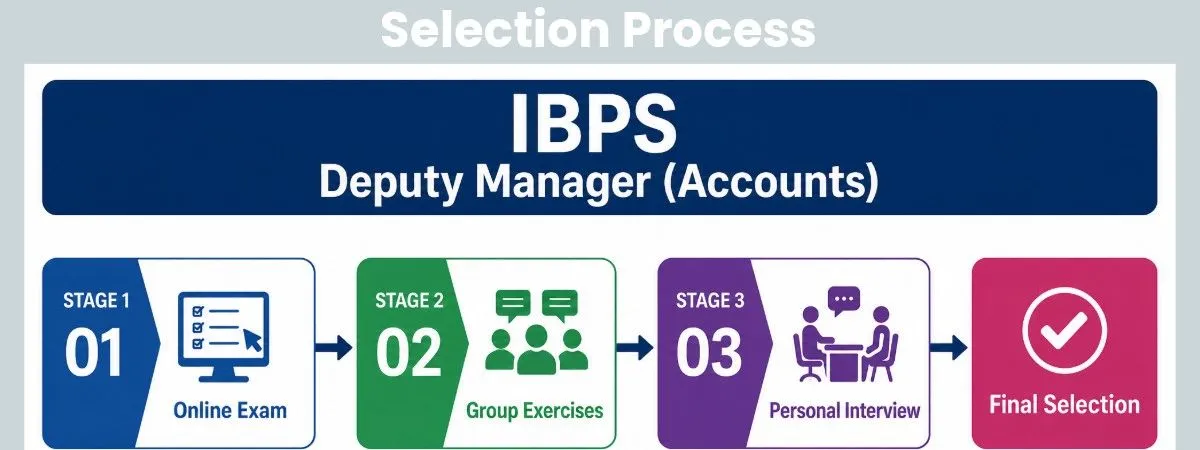
Overview of the three-stage IBPS Deputy Manager (Accounts) selection process including the online exam, group exercises, and interview.
Understanding the Three-Stage Selection Process
The recruitment process happens in three distinct stages. Each stage tests different aspects of your personality and knowledge.
| Stage Number | Stage Name | What Gets Evaluated |
|---|---|---|
| 1 | Online Written Exam | Speed, Accuracy, and Professional Knowledge |
| 2 | Group Exercises | Leadership, Teamwork, and Communication Skills |
| 3 | Personal Interview | Technical Knowledge, Articleship Experience, and Overall Personality |
Stage 2 and Stage 3 together are often called “Group Exercises and Interview” (GEI). Both stages have combined weightage in the final selection process.
Candidates preparing for banking recruitment exams can also check our
latest banking vacancy updates
for additional opportunities.
Exam Pattern: Marks Distribution and Time Allocation
The online examination carries a total of 200 marks. You get 155 minutes to answer 200 questions. A quick calculation shows you need to solve approximately 1.3 questions per minute. This makes speed practice extremely important.
The IBPS Deputy Manager (Accounts) exam consists of 200 questions carrying 200 marks. The test includes Reasoning Ability, English Language, Quantitative Aptitude, and Professional Knowledge sections with a total duration of 155 minutes.
| Subject Area | Questions | Marks | Time Given |
|---|---|---|---|
| Reasoning Ability | 50 | 50 | 35 minutes |
| English Language | 50 | 25 | 35 minutes |
| Quantitative Aptitude | 50 | 50 | 35 minutes |
| Professional Knowledge | 50 | 75 | 50 minutes |
| Total | 200 | 200 | 155 minutes |
Subject-Wise Syllabus with Priority Levels
The syllabus has been divided practically below. Each topic also mentions how much focus it deserves.
Reasoning Ability (50 Marks, 35 Minutes)
This section consumes time. Marks come from accuracy, not just speed.
- Give High Priority to: Puzzles (Circular, Linear, Box based), Seating Arrangement, Syllogism, Coding-Decoding, Blood Relations
- Give Medium Priority to: Inequalities, Direction Sense, Data Sufficiency
- Give Low Priority to: Input-Output, Order Ranking
English Language (25 Marks, 35 Minutes)
This section carries only 25 marks but gives you 35 minutes. Complete it quickly to save time for other sections.
- Must Practice: Reading Comprehension (focus on banking and economy passages), Cloze Test, Error Detection
- Good to Practice: Para Jumbles, Fillers, Sentence Improvement
- Vocabulary Building: Synonyms and Antonyms will improve naturally with regular reading habits
Quantitative Aptitude (50 Marks, 35 Minutes)
This section demands speed. Daily practice makes it manageable.
- Give High Priority to: Data Interpretation (Bar graphs, Line graphs, Pie charts, Tabular data), Number Series, Quadratic Equations, Simplification
- Give Medium Priority to: Percentage, Profit-Loss, Ratio, Average, Time-Work, Time-Speed-Distance, Simple and Compound Interest
- Give Low Priority to: Partnership, Mixture, Probability, Mensuration
Chartered Accountants have a strong advantage in the Professional Knowledge section due to their background in accounting, auditing, taxation, and finance.
Professional Knowledge (75 Marks, 50 Minutes) – Most Critical Section
This section gives CA candidates their biggest advantage. Scoring well here is easier for you compared to other sections where competition is fierce.
Accounting (25 to 30 marks – Highest Priority)
- Accounting Standards (AS) and Ind AS – up to basic application level
- Preparation of Financial Statements (Balance Sheet, Profit & Loss, Cash Flow)
- Consolidation of Accounts (CA Intermediate level, not Final level)
- Partnership Accounts and Company Accounts
- Cost Accounting – Marginal Costing, Budgetary Control, Standard Costing
Auditing (15 to 20 marks)
- Audit Planning, Internal Control, Internal Audit
- Vouching and Verification procedures
- Standards on Auditing (basic concepts)
- Audit Reports – Types and format
- Bank Audit and Tax Audit basics
Taxation (15 to 20 marks)
- Direct Tax: Residential status, Income from salary, house property, capital gains, business, TDS provisions, Deductions under sections 80C to 80U
- Indirect Tax (GST): Supply rules, Input Tax Credit (ITC), Registration, Returns (GSTR-1, GSTR-3B), Composition Scheme
- Minimum Alternate Tax (MAT) basics
Financial Management (10 to 15 marks)
- Capital Budgeting (NPV, IRR, Payback Period)
- Working Capital Management (Cash, Inventory, Receivables)
- Cost of Capital (WACC)
- Leverage Analysis
Corporate Laws (5 to 10 marks)
- Companies Act – Company Formation, Directors, Meetings, Share Capital
- Corporate Governance basics
- SEBI basics
Banking and Financial Awareness (5 marks)
- RBI Functions, Monetary Policy, Banking Regulations, BASEL norms
- Budget, Economic Survey, Inflation, GDP, Banking Reforms
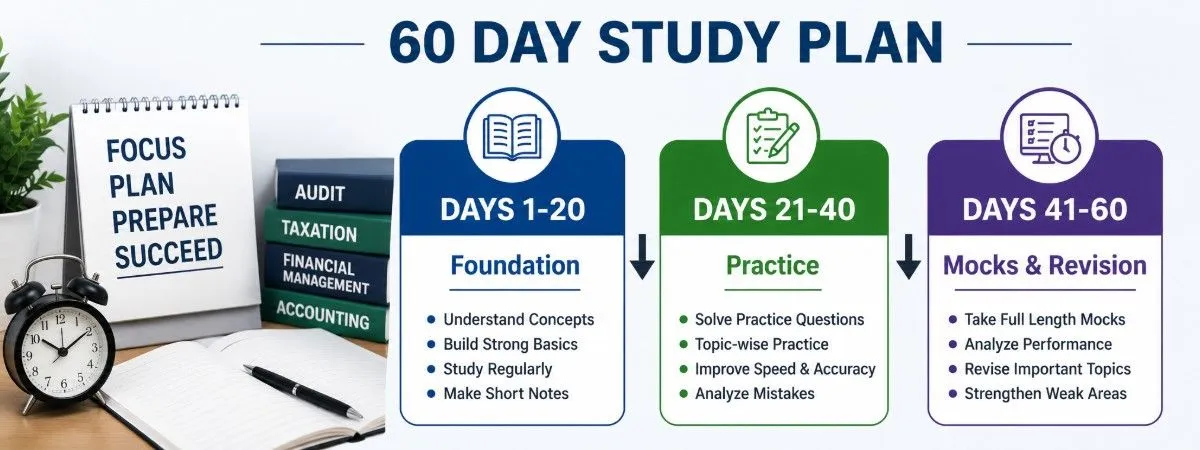
A structured 60-day study plan covering foundation building, practice sessions, mock tests, and final revision for the IBPS Deputy Manager (Accounts) exam.
60-Day Study Plan Designed Specifically for CAs
This plan works well for both qualified CAs and CA Final level students. If you are still a student, spend more time on Professional Knowledge.
First 20 Days – Building the Foundation
- Professional Knowledge (3 hours daily): Revise CA Intermediate level Accounting Standards, Income Tax, GST, and Auditing basics
- Reasoning (1 hour): Daily practice of puzzles and seating arrangement questions
- Quantitative Aptitude (1 hour): Focus on Data Interpretation, Number Series, and Simplification
- English (30 minutes): One Reading Comprehension and one Cloze Test daily
Next 20 Days – Practice and Speed Building
- Take 2 to 3 mock tests weekly, especially sectional tests for Professional Knowledge
- Cover Financial Management and Cost Accounting topics
- Practice advanced puzzles in Reasoning
- Solve 3 to 4 Data Interpretation sets daily
- Analyze your mistakes and keep a notebook of wrong answers
Final 20 Days – Revision and Full Mock Tests
- Take one full-length mock test daily under exam-like conditions
- Solve previous years’ IBPS Deputy Manager question papers
- Do intensive revision of Professional Knowledge
- Start interview preparation by turning your articleship experiences into stories
- Review monthly banking awareness and current affairs compilations
Recommended Books and Study Resources
| Subject | Book Title | Author or Publisher |
|---|---|---|
| Reasoning | Analytical Reasoning | M.K. Pandey |
| Quantitative Aptitude | Quantitative Aptitude for Competitive Examinations | R.S. Aggarwal |
| English | Objective General English | S.P. Bakshi |
| Professional Knowledge (Accounting) | ICAI Study Material (CA Inter and Final) | ICAI |
| Professional Knowledge (Taxation) | Income Tax and GST Ready Reckoner | Taxmann |
| Professional Knowledge (Auditing) | Auditing and Assurance (CA Inter) | ICAI |
| Current Affairs | Monthly Banking Awareness | Any standard publication |
Interview Stage: Where Your CA Degree Gets Tested Thoroughly
The interview panel evaluates your knowledge of accounting, taxation, and auditing. But they also assess your articleship experience, problem-solving approach, and understanding of the banking domain.
Common Questions Asked in the Interview:
- Why did you choose Chartered Accountancy? Tell us about your articleship experience.
- How do you stay updated with changes in Accounting Standards?
- What are the recent amendments in GST?
- What kind of income tax work did you handle during articleship?
- How is NPA accounting handled from a bank’s perspective?
- What impact has IND AS adoption made on the banking industry?
- How do RBI’s recent circulars affect the accounts department?
- What challenges did you face during bank audits in your articleship?
- Why do you want to join IBPS instead of starting your own practice?
- Where do you see yourself five years from now?
5 Critical Mistakes That Can Cost You Selection
| Mistake | Why It Hurts | Right Approach |
|---|---|---|
| Ignoring Professional Knowledge | This section carries the highest weightage and often determines final selection. | Focus on Accounting, Auditing, Taxation, and Financial Management concepts. |
| Taking Negative Marking Lightly | Multiple incorrect answers can significantly reduce your overall score. | Attempt questions only when you can confidently eliminate wrong options. |
| Skipping Mock Tests | Lack of practice leads to poor speed and time management in the actual exam. | Take regular full-length mock tests and analyze your mistakes. |
| Ignoring Banking Awareness | Even a few banking-related questions can impact your final score. | Stay updated with RBI policies, banking reforms, and financial news. |
| Going to the Interview Unprepared | A strong written score alone cannot guarantee final selection. | Revise articleship experience, technical concepts, and common interview questions. |
SBI PO Recruitment 2026: 1500 Probationary Officer Vacancies Apply Online
State Bank of India PO recruitment details including eligibility, dates, and application process.
SBI Recruitment 2026 for Concurrent Auditor: Eligibility and Selection Process
Understand how audit and accounting experience is used in banking sector recruitment.
UPCISB Bank Vacancy 2026: Latest Banking Recruitment Updates
Explore another banking recruitment opportunity and compare eligibility requirements.
Government Job Preparation Guide: Study Plan and Exam Strategy
Learn practical preparation techniques, mock-test planning, and revision methods.
Answers to Common Questions Asked by CA Candidates
Final Words of Motivation for CA Aspirants
The IBPS Deputy Manager (Accounts) role truly values your CA degree. No sales targets. No customer dealing. Just pure accounting and finance work.
Add to this the security of a government job, a pension after retirement, and fixed working hours. Promotions come with salary increases – the career path leads to Chief Manager, AGM, DGM, and GM positions.
If you have genuine interest in accounts and finance and want a respectable, stable career, do not miss this opportunity.
Wishing you the best for your IBPS Deputy Manager (Accounts) preparation. Start today, stay consistent, and make full use of your CA degree.
Disclaimer: This guide is based on previous years’ IBPS Deputy Manager (Accounts) recruitment patterns. Candidates must check the official notification on ibps.in for the latest updates, exact syllabus, and eligibility criteria before applying.